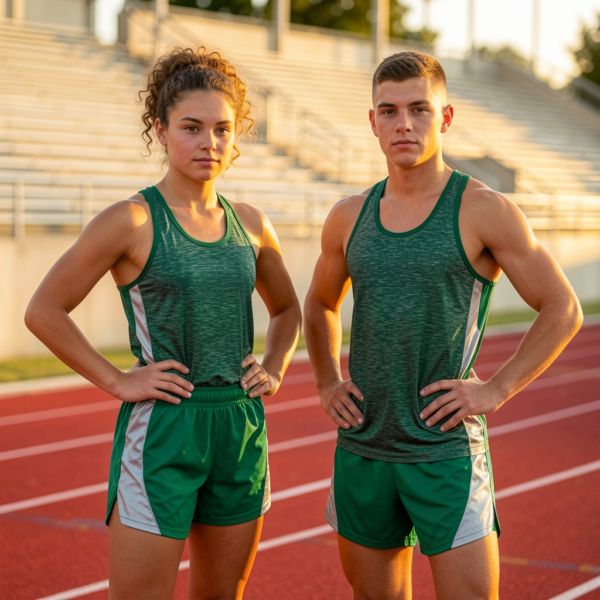
Budget Custom Team Uniforms That Look Incredibly Expensive

Cheap Custom Team Jerseys That Still Look Game-Ready

To find cheap custom team jerseys that look sharp, start with a simple design, choose a durable polyester fabric, and collect every player’s size before requesting a quote. Ask for the total delivered price, including names, numbers, setup, and shipping. Budget jerseys often run about $15 to $35 each, but those extras can change the final cost.

For school and youth teams, the best value is a jersey that fits, holds up to washing, and arrives before the first game.
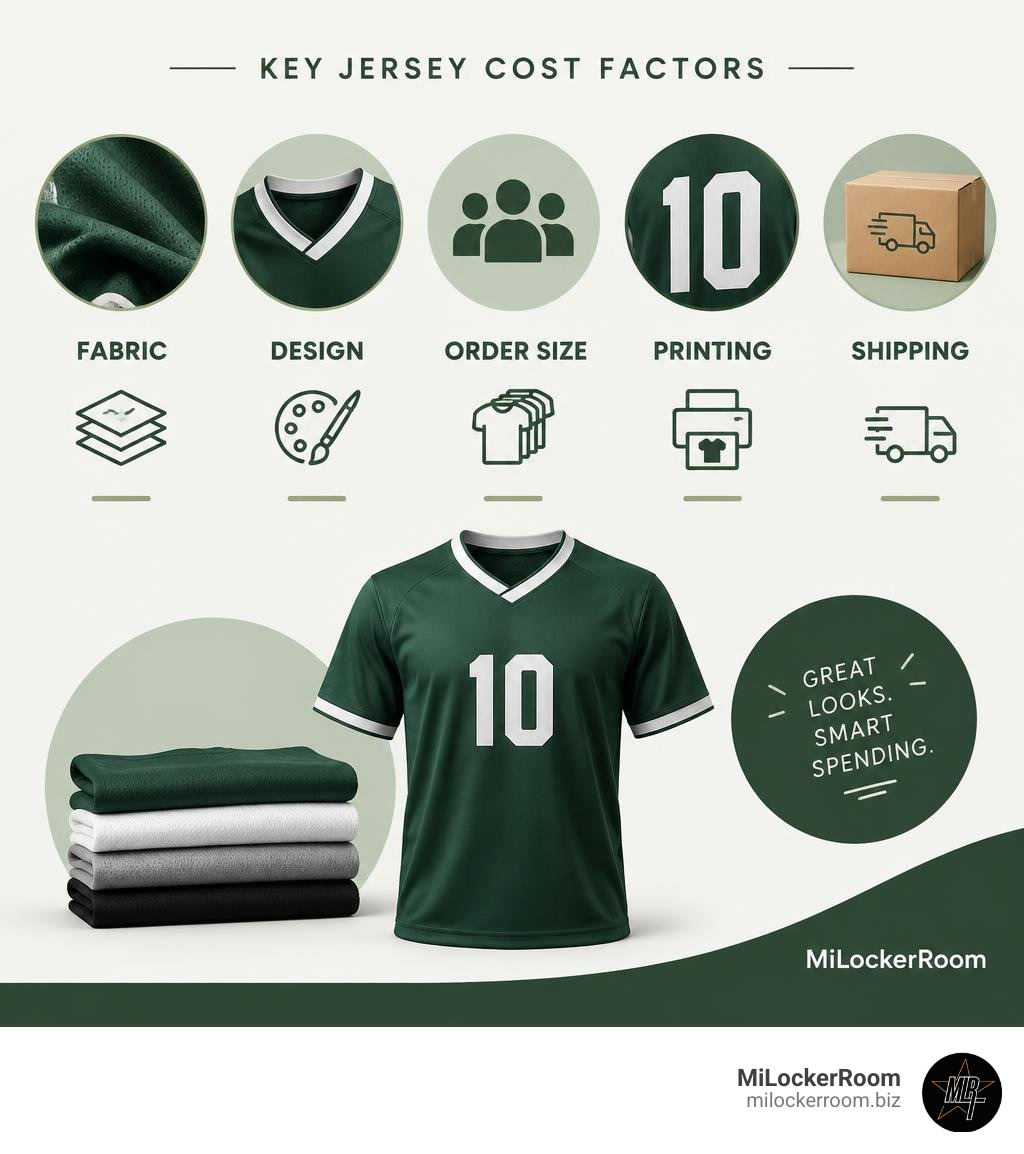
Key jersey cost factors: fabric, design, order size, printing, and shipping infographic

Staying on budget doesn’t mean your roster has to take the field looking like they raided a discount bin from 1998. Today, athletic apparel technology allows community clubs, high schools, and weekend rec squads to build high-end uniforms without breaking the bank. The global demand for affordable team personalization continues to surge, with over 60% of amateur sports organizations aiming to keep per-unit kit costs under $30.

Whether you are outfitting a first-time youth soccer league or outfitting a competitive adult softball team, understanding the manufacturing and ordering process ensures you maximize every dollar spent.

How to Choose the Right Materials and Printing for Cheap Custom Team Jerseys

When you balance style and affordability, selecting the proper garment foundation is critical. A jersey can feature the most striking artwork in the league, but if the fabric retains moisture or tears at the first slide into second base, the savings disappear quickly.

Best Fabrics for Long-Lasting Performance

Standard cotton t-shirts might look like an easy cost-saver, but they quickly turn heavy with sweat and fade after three cycles through the laundry. The modern standard for dependable athletic sports apparel is 100% moisture-wicking polyester interlock or micro-mesh.

Polyester fibers resist stretching, shrinking, and snagging while pulling sweat away from the athlete’s skin.

  • Polyester Interlock: A smooth, tightly knit fabric that provides an even surface for crisp graphic printing. It feels soft against the skin, drapes cleanly, and offers high tear resistance.
  • Poly-Mesh and Pin-Dot Knits: Lightweight weaves engineered with microscopic holes that maximize airflow. These work exceptionally well as inserts under arms or across the back yoke for high-heat outdoor play.
  • Reinforced Seams: Look for garments constructed with flatlock or double-needle cover-stitching. This prevents friction against the player’s body and stops seams from unraveling under physical strain.
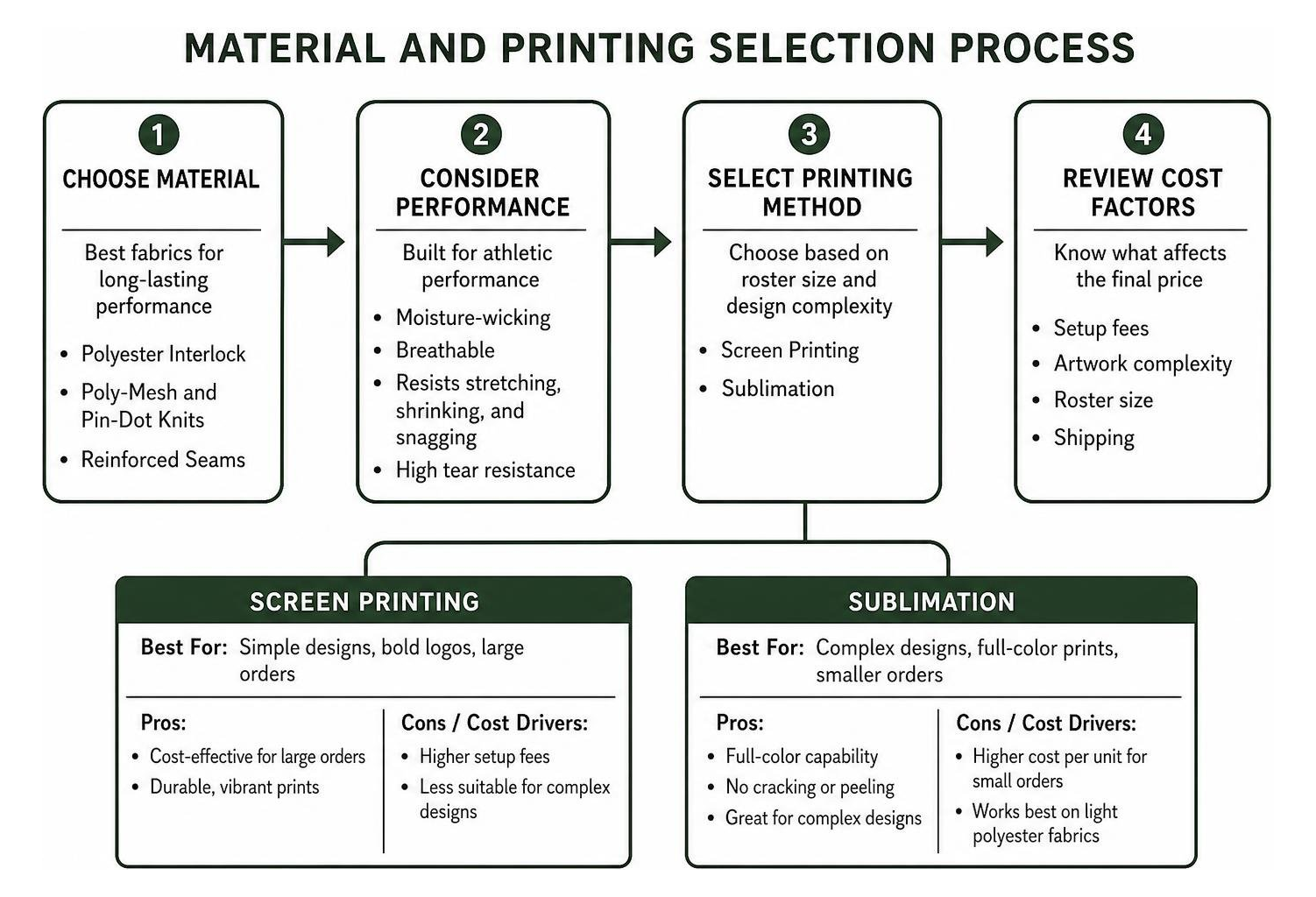
Material and printing selection process flow

Screen Printing vs. Sublimation for Cheap Custom Team Jerseys

The printing method you select determines not only how vivid your uniforms look, but also how high your setup fees climb. Depending on your roster size and logo complexity, different custom jersey customization options yield significantly different price tags.

Method Best For Pros Cons / Cost Drivers
Spot-Color Screen Printing Medium to large bulk orders with 1–2 ink colors Low unit cost at high volumes; thick, vibrant finish Screen creation fees per color; prone to cracking over time if cured improperly
Dye-Sublimation Intricate multi-color crests, all-over patterns, gradients Ink infuses directly into the fabric fibers; zero cracking/peeling; unlimited design elements Requires 100% white/light polyester base garments; higher baseline entry price
Direct-to-Film (DTF) & Heat Transfer Small batches, complex crests, individualized roster numbers Great detail reproduction; no multi-screen setup costs; cost-effective for small runs Slightly heavier hand feel on lightweight jerseys; requires proper wash care to avoid edge peeling

For teams wanting crisp block lettering and classic numbering on a solid-color jersey, traditional 1-color or 2-color screen printing offers the lowest per-unit entry point. However, if your team crest uses five distinct colors, shading, or shoulder-to-hip patterns, full dye-sublimation eliminates costly screen setup fees because all design elements, names, and numbers are fused into the garment in a single step.

Practical Strategies to Cut Costs on Team Uniform Orders

Cutting equipment costs comes down to proactive planning. Last-minute decisions, scattered roster updates, and excessive decoration locations inflate price quotes rapidly.

Smart Ordering Tactics for Cheap Custom Team Jerseys

organized team roster and uniform distribution

Approximately 72% of youth sports organizations buy uniforms in bulk tiers (10+ units) to lower their per-jersey rate. Ordering together creates volume discounts that lower your final invoice.

  1. Consolidate Roster Numbers Early: Collect player sizes, number selections, and name spellings in one centralized master sheet before submitting your artwork. Placing small re-orders later triggers individual setup fees, shipping minimums, and higher single-piece pricing.
  2. Limit Print Locations: A jersey with a front chest logo and a back number is economical and professional. Adding left-chest badges, right-sleeve logos, lower-back sponsor names, and neck tags multiplies machine passes and increases labor costs.
  3. Standardize Sizing Packages: Avoid bespoke cuts if your league does not require them. Choosing standard athletic unisex cuts across youth and adult tiers allows suppliers to source base blanks at bulk wholesale pricing.
  4. Use Integrated Uniform Packages: Bundling tops with matching shorts, socks, or practice gear through unified custom team uniforms and apparel programs keeps material colors consistent and secures multi-piece discounts.

Avoiding Costly Shipping and Turnaround Pitfalls

A uniform that costs $18 on paper can quickly become a $35 headache if hit with rush production and expedited freight charges.

  • Watch Out for Proofing Delays: Custom production schedules pause until digital artwork proofs receive written approval. Delaying proof reviews by three days can push your delivery past game day or force unexpected rush charges.
  • Account for Off-Peak Turnaround: Sourcing gear during your sport’s peak pre-season (e.g., late August for fall leagues, early March for spring leagues) strains supply lines. Placing orders 4 to 6 weeks in advance shields your league from premium shipping fees.
  • Avoid Fragmented Delivery Points: Ship the entire team order to a single coach or team manager address rather than splitting delivery across individual residential homes.

What Influences the True Price Range of Custom Jerseys?

Understanding where your money goes inside a supplier’s invoice allows you to adjust design specs without sacrificing visual appeal.

Breaking Down the $15 to $35 Budget Tier

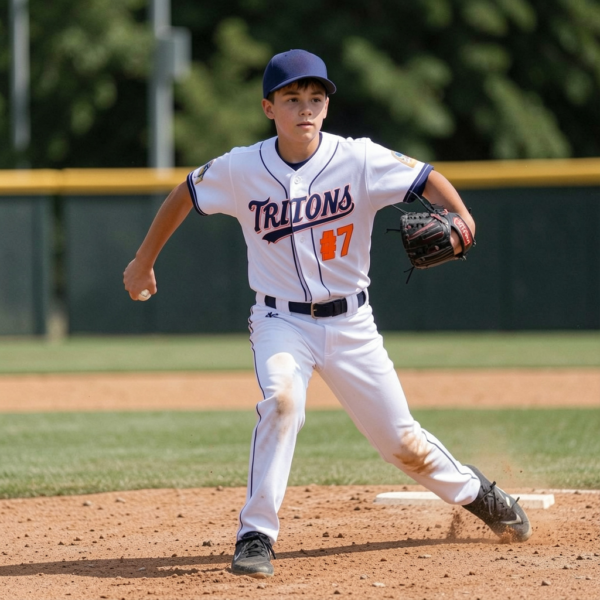
high quality custom baseball jersey on field

A low-cost custom jersey typically falls between $15 and $35, whereas premium retail brands charge $50 to $100 or more for similar foundational poly-interlock knits.

When outfitting specialty squads, such as ordering custom baseball jerseys for teams, you will find price adjustments tied to specific styling elements:

  • Base Garment Style: Crewneck tees represent the lowest entry cost. V-necks and raglan-sleeve jerseys add modest assembly costs, while full-button front baseball tops or zippered collars sit at the higher end of the budget spectrum.
  • Number of Decoration Colors: In screen printing, every distinct color requires its own screen preparation, burning, and wash-down process. A one-color white chest print on a navy jersey is far more affordable than a four-color outlined logo.
  • Roster Customization Complexity: Heat-applied vinyl or sublimated player names add extra labor compared to simple sequential back numbering (e.g., numbers 1 through 18).

Evaluating Vendor Reputation and Return Policies

Budget gear should never mean rolling the dice on illegible numbering or missed delivery dates. Before submitting payment:

  • Check Replacement and Misprint Policies: Ensure the supplier provides clear terms for re-running garments if a name is misspelled on their end or if print alignment is visibly skewed.
  • Evaluate Sizing Charts and Samples: Size scales vary between manufacturers. Always measure chest width and garment length from armpit to hem against an existing comfortable jersey rather than guessing based on general size labels.
  • Verify Production Infrastructure: Companies operating dedicated in-house decoration facilities maintain tighter quality control and schedule accuracy compared to third-party brokers who outsource printing across disconnected subcontractors.

Frequently Asked Questions About Budget Custom Uniforms

What is the most affordable printing method for custom team uniforms?

For standard team orders (12 pieces or more), single-color spot screen printing on the front with single-color numbers on the back is the most affordable printing method. It eliminates complex setup fees while delivering crisp, long-lasting visuals that hold up through rigorous gameplay.

How far in advance should recreational teams place uniform orders?

Teams should finalize rosters and place their custom uniform orders 3 to 5 weeks before their first scheduled scrimmage or photo day. This window allows ample time for digital mockup revisions, physical manufacturing, quality assurance inspections, and ground shipping without paying rush fees.

Can budget jerseys withstand frequent washing and intense gameplay?

Yes, provided they are made from 100% micro-polyester interlock and washed correctly. To preserve print vibrancy and seam integrity, wash jerseys inside-out in cold water using mild detergent. Avoid fabric softeners—which clog moisture-wicking pores—and hang dry or tumble dry on low heat.

Conclusion

Outfitting your roster in clean, matching, high-performance athletic gear does not require draining your team’s treasury. By focusing on moisture-wicking polyester blanks, streamlining logo colors, ordering in bulk tiers, and planning ahead of opening day, you can field a squad that looks and feels like top-tier contenders.

At MiLockerRoom, we simplify the uniform process by pairing teams one-on-one with experienced coaches who provide personalized, ground-up design guidance backed by reliable in-house production. Explore our custom team uniforms crafted for every league to get durable, game-ready gear delivered on schedule and within your budget.
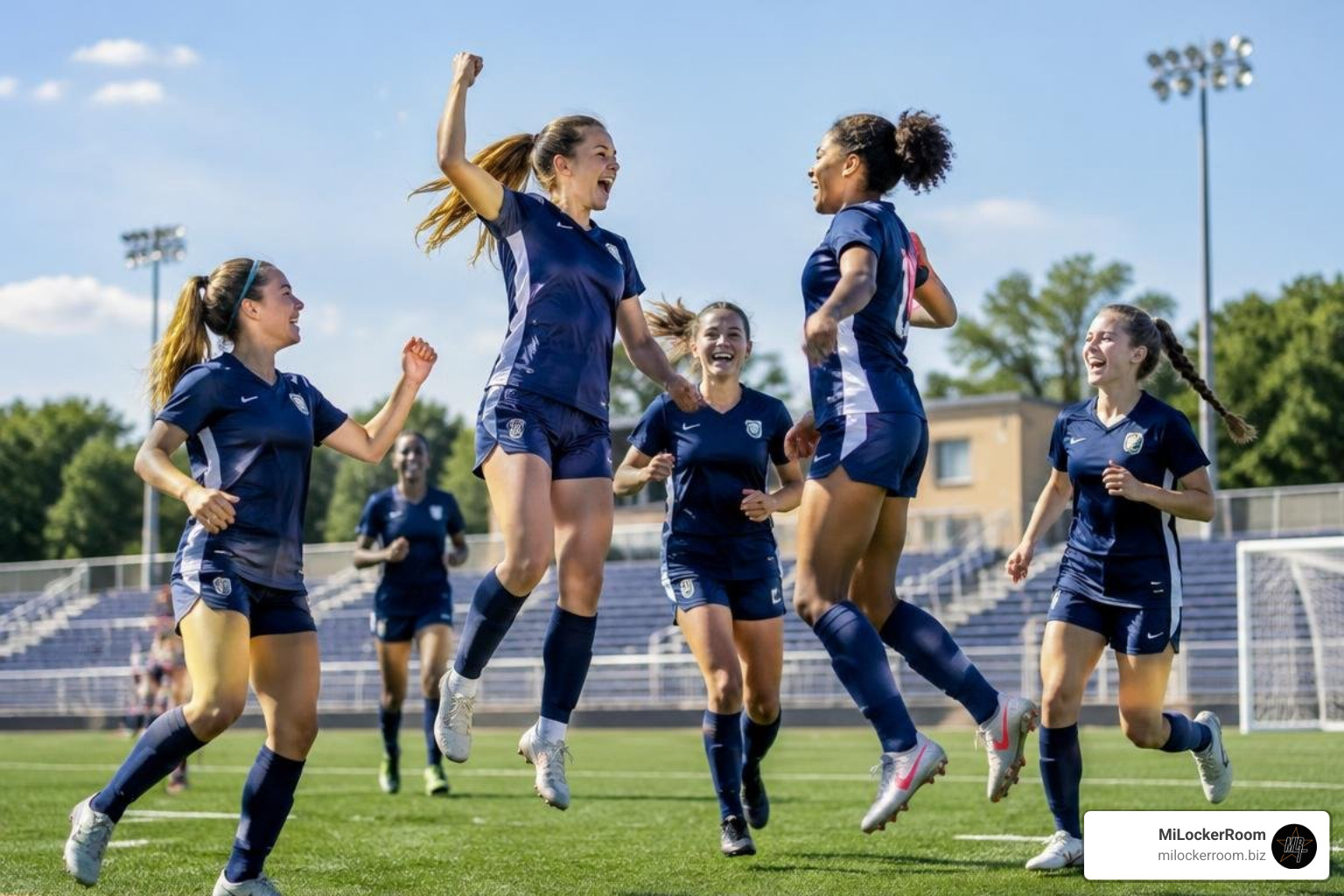
Level Up Your Matchday Look with Custom Uniforms for Soccer

Custom Uniforms for Soccer That Are Ready for Matchday

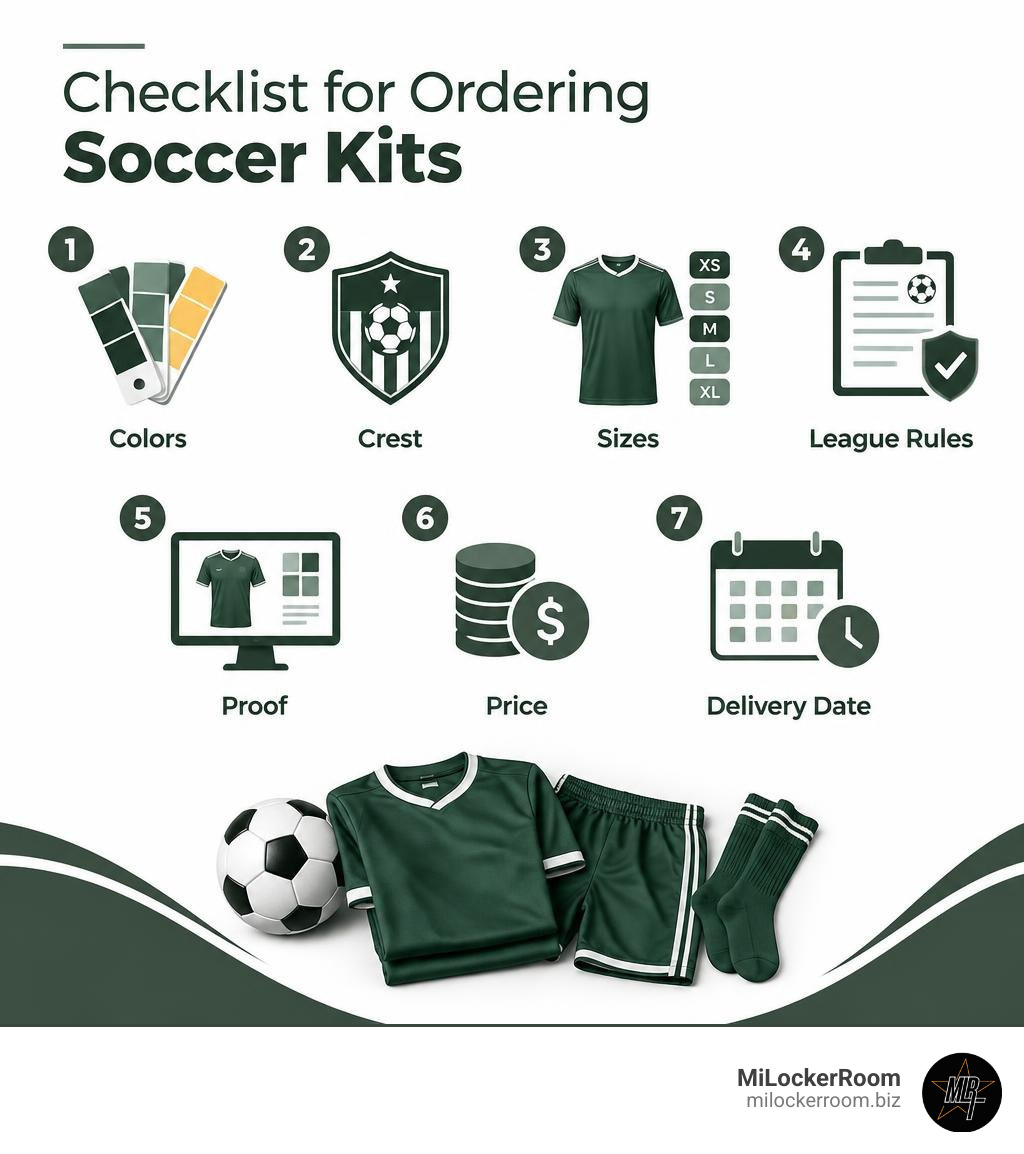
To order custom uniforms for soccer, start with your core team colors, official crest, roster details, and exact size requirements across every age division. It is essential to double-check your governing league’s equipment guidelines before committing to artwork. Always request a digital design proof, a transparent price breakdown with bulk tiering, and a confirmed delivery timeline prior to approving your production order. Establishing this structured workflow early helps team administrators, equipment managers, and club directors eliminate unexpected delays, costly reorders, and mismatch issues when several age groups require new matchday kits simultaneously.

A quality match kit must accomplish far more than merely looking professional on the pitch. It has to feel exceptionally comfortable during ninety minutes of play, remain instantly identifiable across the pitch, and authentically capture your club identity. This complete guide breaks down the essential technical materials, graphic customization options, cost management strategies, and ordering phases that matter most for competitive programs.

Checklist for ordering soccer kits: colors, crest, sizes, league rules, proof, price, and delivery date infographic

Why Investing in Custom Uniforms for Soccer Transforms Your Club

Stepping onto the pitch in a coordinated, bespoke kit creates an immediate psychological shift for players, coaching staff, and loyal supporters alike. When your squad dresses like dedicated professionals, they naturally compete with elevated focus, mutual accountability, and self-belief. Contemporary sports psychology research demonstrates that wearing tailored, unified gear can increase team cohesion and on-field performance by up to 20%. Rather than feeling like a disconnected collection of individual players wearing generic practice pinnies or off-the-shelf template tops, athletes instantly connect with a shared club mission the moment they pull on their bespoke colors in the locker room.

youth soccer club displaying cohesive custom jerseys

Beyond gameday psychology, customized athletic kits establish substantial visual authority and lasting prestige for your club, competitive academy, or school athletics department. As of 2026, over 60% of amateur soccer teams use custom-designed uniforms, representing a major leap from just 35% a decade ago. High-grade visual branding separates serious programs from casual weekend recreational leagues, giving organizations a meaningful competitive edge when recruiting top coaching talent and attracting local business sponsors. Outfitting squads in premium custom team uniforms apparel also cultivates grassroots community engagement and fan loyalty; amateur and semi-pro clubs outfitted in unique kits report an average 15% increase in supporter merchandise sales compared to programs using plain stock options.

Custom Kit Materials: Durability and Value

Off-the-shelf catalog jerseys often rely on basic, lightweight fabrics paired with cheap heat-pressed vinyl names and numbers that peel, crack, and bubble after a few aggressive wash cycles. Investing in tailored team kits ensures higher fabric longevity, superior seam strength, tear resistance, and lasting colorfastness across multiple grueling competitive seasons. Instead of being forced to reorder entirely new sets every single year due to fraying threads or discontinued manufacturer styles, bespoke manufacturing allows you to preserve your exact design framework and reorder individual fill-in sizes whenever new players join your roster.

Decoration / Fabric Method Durability Level Breathability Best Use Case Longevity Expectation
Dye Sublimation Maximum (infuses fabric) Excellent (zero added weight) Full-kit custom graphics & all-over patterns 3+ seasons without fading
Heat-Applied Vinyl Moderate (prone to peeling) Fair (covers airflow pores) Quick-turnaround names & numbers 1 season of heavy play
Direct Screen Print Good (can crack over time) Moderate (ink blocks small mesh) Basic one-color sponsor logos 1–2 seasons
Woven / Embroidered Crest High (stitched perimeter) N/A (applied over chest) Club badges & official emblems Multiple seasons

Performance Fabrics, Materials, and Modern Kit Technologies

Modern competitive soccer demands explosive acceleration, non-stop stamina, dynamic physical mobility, and tactical flexibility over ninety grueling minutes in varying weather conditions. The global soccer uniform market is projected to reach $2.3 billion by 2027, driven largely by rapid advancements in athletic textile engineering and specialized manufacturing methods. Modern soccer kits are constructed from technical moisture-wicking polyester interlock and jacquard blends featuring four-way mechanical stretch. These advanced textiles allow wingers, midfielders, defenders, and strikers to sprint, slide, pivot, and strike freely without experiencing restrictive fabric tension across the chest, shoulders, or quads.

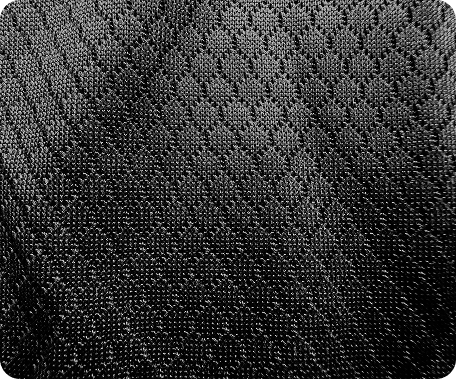
high-performance soccer fabric texture with micro ventilation pores

Strategically integrated micro-mesh ventilation panels along the underarms and side torsos create targeted cooling zones, actively moving excessive body heat and perspiration away from the skin during intense matches. When integrated with performance base layers and multi-functional activewear, these advanced fabrics keep athletes dry and well-regulated under blazing summer conditions and insulated during freezing winter fixtures. Modern garment manufacturing also prioritizes eco-conscious materials, utilizing recycled polyester yarns derived from post-consumer plastics without sacrificing athletic performance, durability, or player comfort.

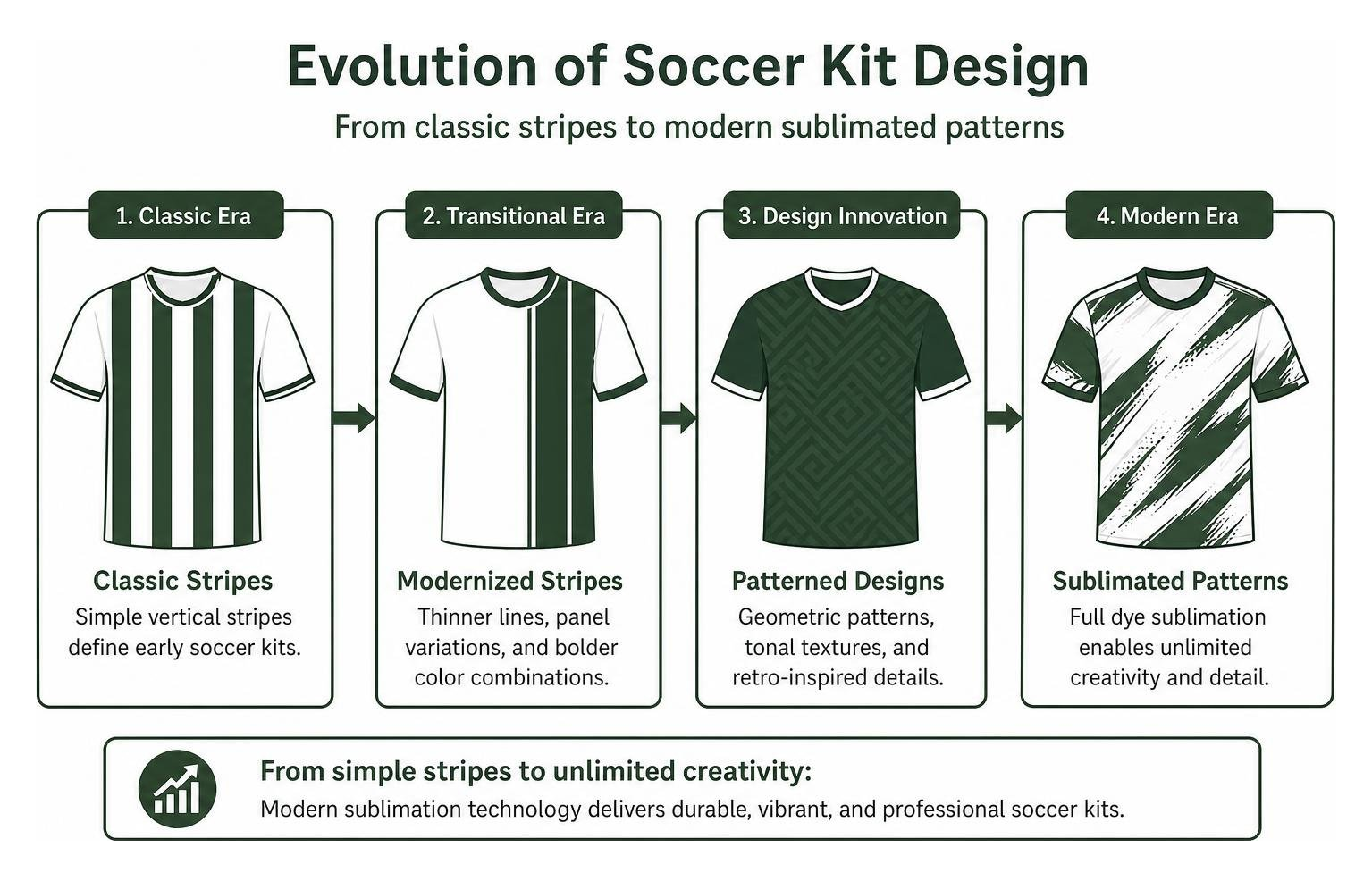
Soccer kit design currently showcases exciting aesthetic movements. Across competitive youth, collegiate, and semi-professional circuits, clubs are reviving 1990s-inspired retro geometric prints, subtle tonal jacquard weaves, and refined vintage polo collars. Full dye sublimation makes these complex visual concepts possible by infusing eco-friendly water-based inks directly into the polymer microfibers using high heat and industrial pressure.

Evolution of soccer kit design showing classic stripes leading to modern sublimated patterns

Sublimation guarantees that intricate sleeve graphics, subtle chest gradients, player names, and numbers never peel, crack, or add heavy bulk to the jersey. It also gives designers total freedom to experiment with minimalist crests, custom sleeve trims, and bold secondary accent colors that stand out under stadium lights.

How to Build the Perfect Soccer Kit: Design and Customization

Building an exceptional match kit requires balancing vibrant color harmony, clear player visibility, and prominent club branding. Start by choosing a primary base color alongside high-contrast secondary tones for trim, numbers, and sponsor placements. Vectorize your club crest to ensure razor-sharp clarity when scaled onto jerseys, shorts, and warm-up gear.

Cohesive design is equally vital when outfitting broader athletic departments that manage multiple programs across different sports. A consistent brand identity across all teams elevates the entire organization.

Essential Steps to Design Custom Uniforms for Soccer

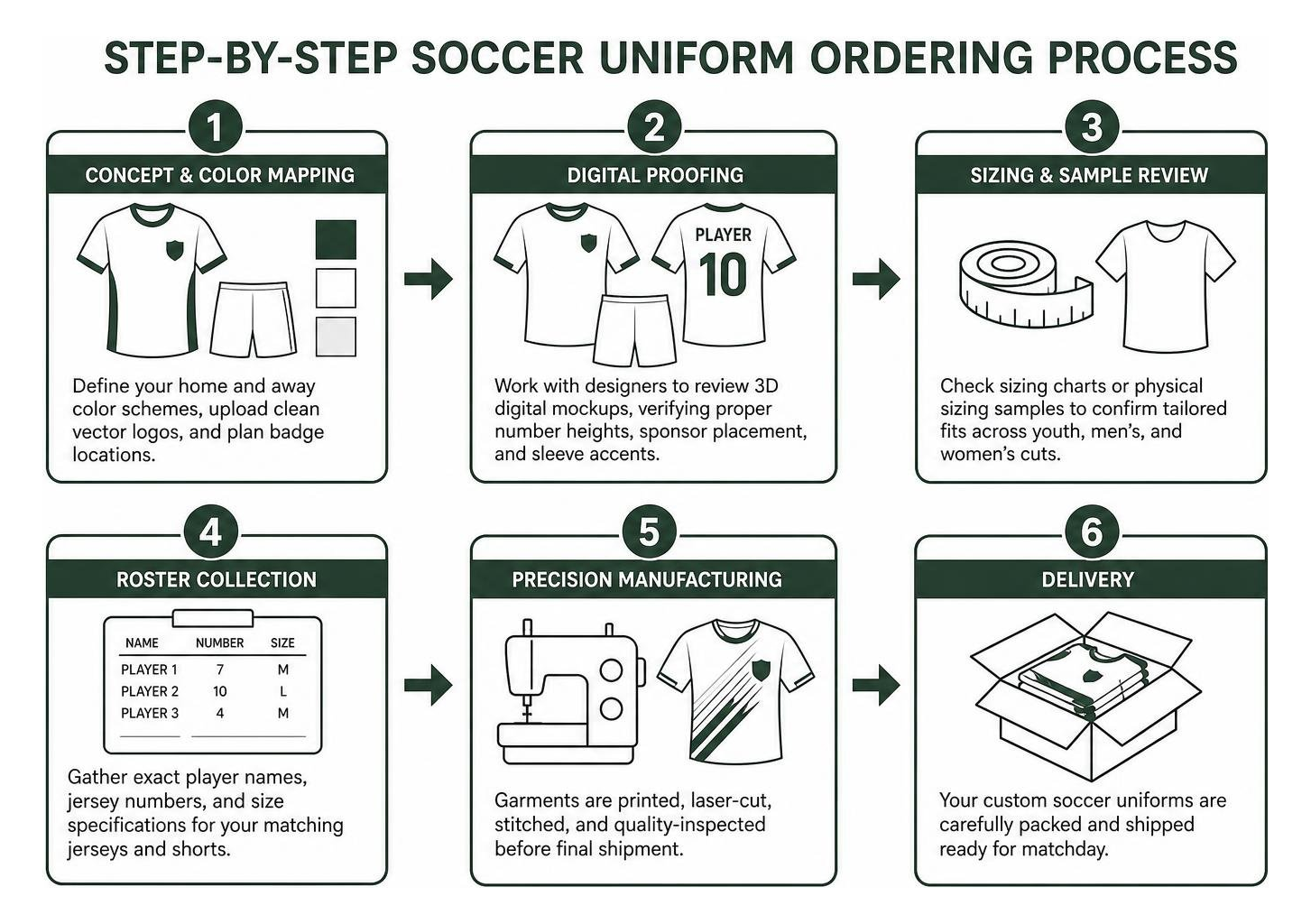
Creating custom uniforms follows a reliable progression from initial concept to matchday kickoff:

  1. Concept & Color Mapping: Define your primary home and away color schemes, establish secondary accent palettes, upload clean vector logos, and plan exact badge locations.
  2. Digital Proofing: Work with professional graphic artists to review 3D digital mockups, verifying proper number heights, sponsor placement, contrast ratios, and sleeve accents.
  3. Sizing & Sample Review: Check sizing charts or physical sizing samples to confirm tailored fits across youth, men’s, and women’s cuts, eliminating fitting discrepancies before bulk production.
  4. Roster Collection: Gather exact player names, jersey numbers, and size specifications for your matching custom jerseys and shorts.
  5. Precision Manufacturing: Garments are printed, laser-cut, stitched, and quality-inspected before final shipment.

Step-by-step soccer uniform ordering process from concept to delivery

Evaluating the Cost of Custom Uniforms for Soccer

A complete custom soccer uniform set (jersey, shorts, and technical socks) typically averages between $45 and $75 per player, depending on fabric grade, stitching complexity, and customization depth. Ordering in bulk delivers significant cost savings; volume orders for entire academies or multi-team clubs regularly reduce per-unit costs by up to 30%. Investing in durable sublimated kits eliminates annual replacement costs associated with cracking prints, keeping club budgets predictable season after season.

Tournament Regulations and Gameday Readiness

Nothing disrupts kickoff like a referee ruling your uniforms non-compliant during equipment inspection. Sanctioned competitive leagues and tournament sanctioning bodies enforce strict rules governing player gear, numbering clarity, crest proportions, and color contrast. To ensure your squad is cleared for kickoff without delay, keep these key regulatory standards in mind:

  • Contrasting Colors: Away kits must distinctly contrast against home kits to prevent visual confusion and color clashes on the field.
  • Dedicated Goalkeeper Sets: Goalkeepers must wear colors distinctly different from outfield teammates, opponents, and match officials.
  • Number Legibility: Back numbers should be at least 8 to 10 inches high, using colors that sharply contrast against the primary jersey background.
  • Accessory Compliance: Undershirts and undershorts must match the dominant sleeve or short color, and external sock tape must match the underlying sock color.
  • Matchday Accessories: Equip your sideline with regulation corner flags, captain armbands, and durable field essentials for seamless gameday management.

Frequently Asked Questions About Soccer Uniforms

How far in advance should teams order custom soccer kits?

We recommend placing your custom uniform order 4 to 6 weeks before your season’s first preseason friendly or tournament fixture. This operational window provides ample time for graphic revisions, sizing confirmations, roster verification, sublimated printing, cut-and-sew assembly, and final shipping, while leaving a practical safety buffer for unexpected late roster additions.

What is the most durable printing method for soccer jerseys?

Dye sublimation is the most durable method for soccer kits. Because the water-based ink bonds molecularly with the polyester fibers under high heat and pressure, the numbers, club crests, and sponsor graphics cannot peel, flake, or crack, even after dozens of high-temperature washes and slide tackles.

How do we ensure custom jerseys comply with tournament rules?

Always review your specific league’s rulebook regarding minimum number heights, badge sizing, and sponsor placements before approving final art proofs. Maintaining high contrast between your base fabric and your jersey numbers ensures seamless compliance during pre-match referee check-ins.

Conclusion

A well-crafted matchday uniform is the foundation of club pride, player confidence, and gameday performance. At MiLockerRoom, we simplify the uniform process by pairing your club one-on-one with experienced coaches who provide personalized, ground-up design guidance backed by reliable in-house production. Step onto the pitch with confidence and design your next championship kit with MiLockerRoom.

Design Ice Hockey Custom Jerseys to Make Your Team the Envy of the League

Choose Ice Hockey Custom Jerseys That Fit Your Team and Timeline

Choose ice hockey custom jerseys by checking four things first: a fit that works over pads, durable fabric, clear names and numbers, and a design that meets your league’s rules. Before you order, confirm the full roster, approve the artwork, and get a delivery date that leaves room before your first game.

A jersey can help players look and feel like one team. For school and youth sports leaders, the harder part is getting every size, name, and number right on time. MiLockerRoom pairs teams with an experienced coach for hands-on design guidance and handles production in-house.

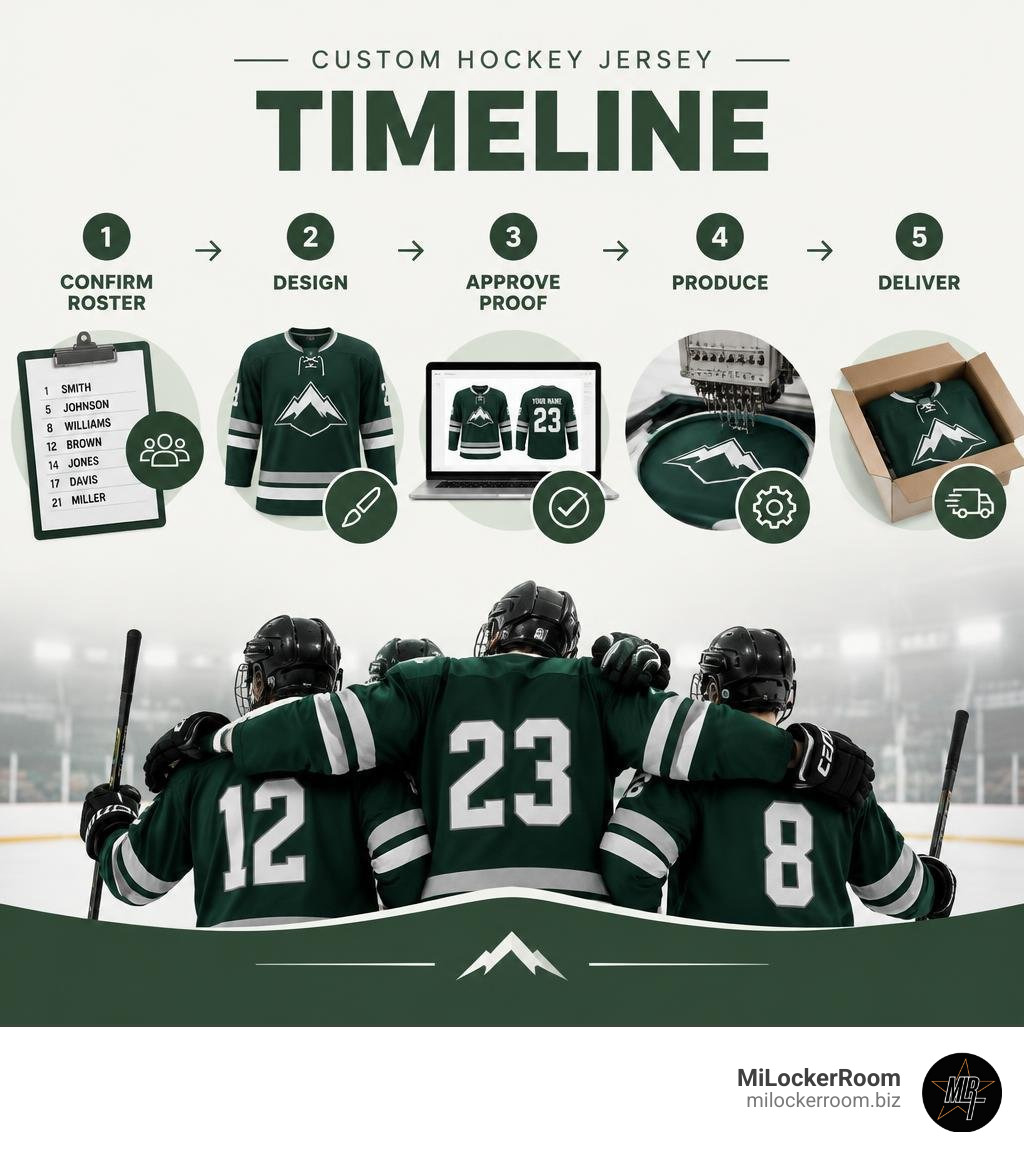
Custom hockey jersey timeline: confirm roster, design, approve proof, produce, deliver infographic

Why Custom Jerseys Strengthen Team Identity

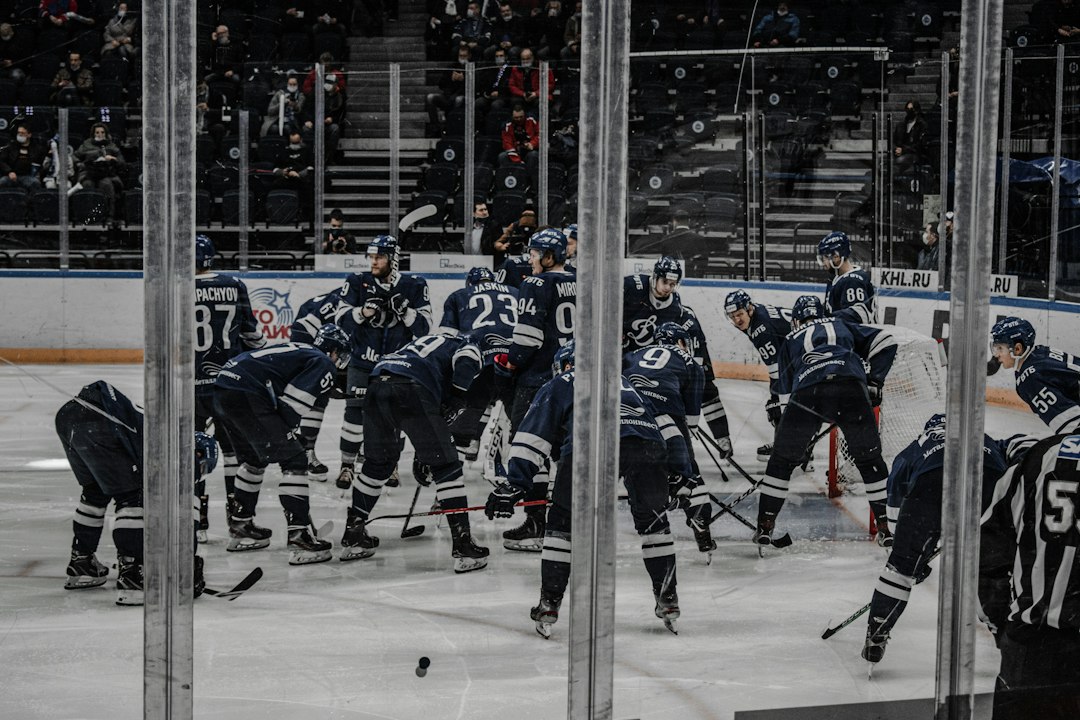
Stepping onto the ice in a generic practice pinnie or an off-the-rack sweater simply does not deliver the same energy as pulling on a fully tailored uniform. In hockey, the sweater is sacred. It carries the weight of your squad’s history, local pride, and collective ambition. When every skater lines up along the blue line wearing identical, sharp uniforms, it instantly establishes mutual respect and psychological readiness before the puck even drops.

The broader sporting world reflects this cultural focus. The global custom sports jersey market is projected to expand at a compound annual growth rate of 8.5% through 2030, largely fueled by rising demand for personalized apparel across grassroots, school, and recreational leagues. In hockey, the connection is especially pronounced: research shows that over 60% of ice hockey players prefer custom jerseys over stock options to build a stronger sense of team identity and individual pride.

Beyond looking clean on game day, quality apparel plays a tangible role in player retention and team morale. When clubs invest in high-grade custom team uniforms, athletes feel valued. Whether managing a high school varsity program, an adult rec league squad, or a youth travel club, visual cohesion builds belonging. Personalized elements like unique color palettes, bold striping, and sharp typography turn a collection of individuals into a unified unit that opponents notice immediately.

Key Materials and Performance Features for Durability

Hockey is tough on apparel. Between skate blades, stick checks, abrasive boards, and Velcro from protective pads, standard athletic shirts quickly tear under rink conditions. Crafting a sweater that lasts through grueling seasons requires heavy-duty synthetic knits designed specifically for contact sports.

The foundation of any high-performance hockey jersey is polyester knit construction. Modern fabrics balance heavy abrasion resistance with moisture management, pulling heavy sweat away from the body so skaters do not carry extra water weight during extended shifts.

Fabric Type Weight / Density Primary Benefits Best Application Durability Level
Heavy-Duty Airknit High (200–240 GSM) Breathable open-mesh weave, exceptional snag resistance Main body, heavy-contact amateur and pro play Extremely High
Pro-Brite / Dazzle High (200–220 GSM) Lustrous smooth finish, vibrant color reproduction Shoulders, accent yokes, decorative inserts High
Pro-Mesh / Flow Knit Lightweight (150–180 GSM) Maximum airflow, quick drying, flexible stretch Underarm gussets, side ventilation panels Moderate to High
Kevlar / Reinforced Poly Very High (260+ GSM) Cut and tear resistance, structural support Elbow caps, forearm wear zones Maximum

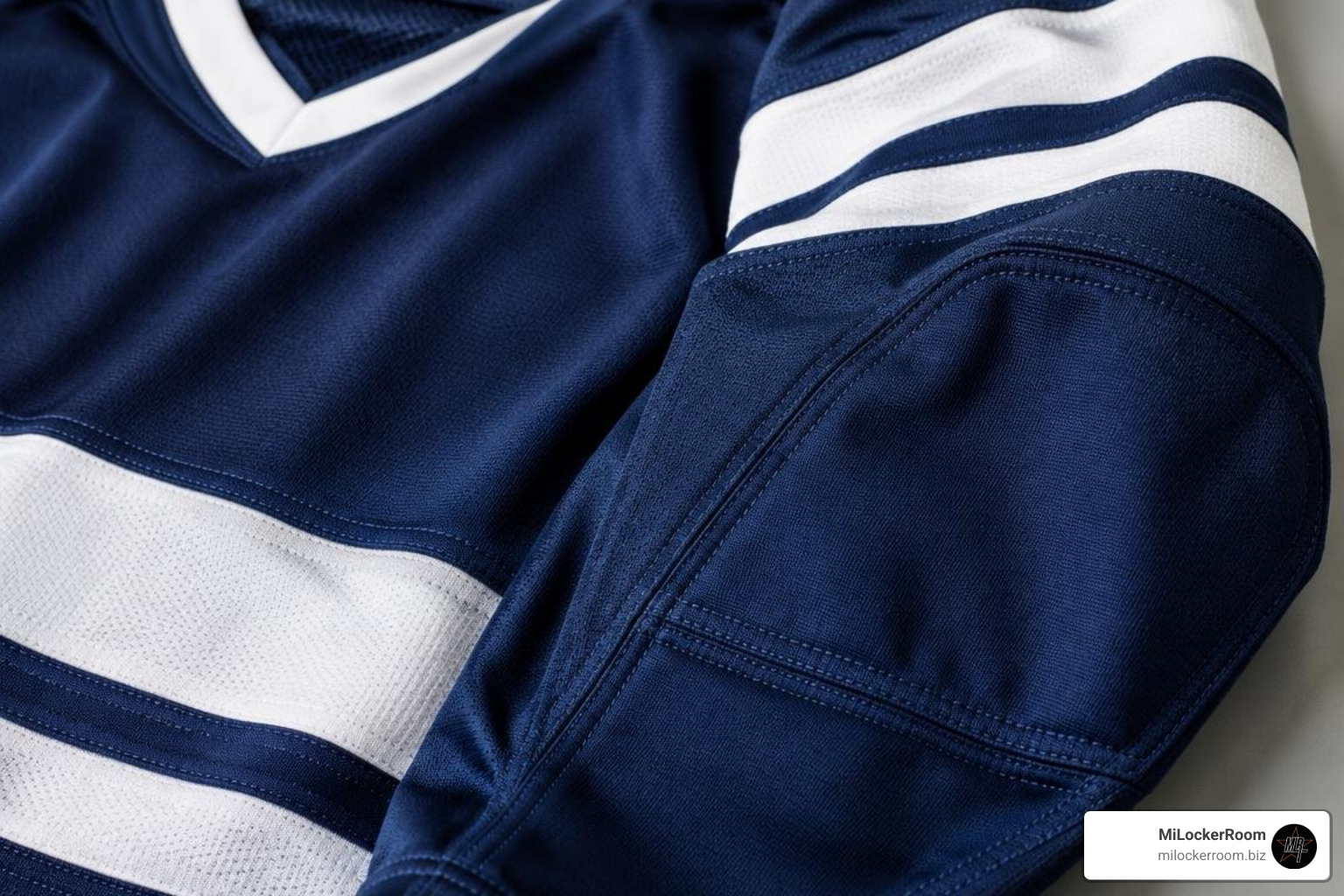
reinforced hockey jersey stitching and fabric details

To withstand physical play, look for these structural details:

  • Reinforced Elbows and Shoulders: High-wear zones need dual-layer fabric panels to resist tears when players fall or rub against the glass.
  • Interlock Double Stitching: Seams along the sleeves and shoulders should feature multi-needle cover stitching to prevent splitting during physical battles.
  • Ventilation Gussets: Breathable mesh inserts under the arms release heat and allow natural movement through stickhandling and shooting motions.
  • Fight Straps: Pro-cut sweaters feature an interior tie-down strap that attaches directly to the pant waistband, keeping the jersey securely positioned during contact.

Essential Features When Ordering Ice Hockey Custom Jerseys

Getting the design right requires attention to cut, structure, and graphic construction. A standard sports cut will not work over bulky shoulder pads and elbow protectors.

When choosing cuts, teams generally select between traditional wide cuts (featuring loose, boxy torsos with wide sleeves) and modern athletic tapered cuts. Athletic cuts keep excess fabric closer to the pads to minimize grab points along the boards. Collar construction also shapes both style and comfort. Popular collar styles include:

  • V-Neck with Insert: A classic, flexible option providing quick ventilation.
  • Laced Pro Collar: Offers vintage appeal using functional or decorative hockey laces.
  • Keyhole / Tapered Collar: Modern style featuring a small fabric crossover at the base of the throat.

Color consistency is equally essential. When moving digital concepts to real fabrics, exact Pantone or CMYK matching ensures that your crest colors match sleeve striping, socks, and pant shells across every production run.

Core Printing Methods for Ice Hockey Custom Jerseys

The method used to apply your artwork determines how long your uniform looks pristine. While screen printing works fine for standard cotton t-shirts, hockey gear requires more durable methods.

Sublimation has become the industry standard for modern athletic uniforms, contributing to a 22% year-over-year increase in custom hockey jersey sales since 2020. Through dye sublimation, high-heat inks bond directly with the synthetic polyester fibers. This makes the graphics completely permanent: they will not crack, peel, or fade, and the jersey stays light and breathable.

Teams seeking a classic, premium look often choose tackle twill and direct embroidery. Tackle twill uses individual nylon or polyester fabric layers cut to shape and machine-stitched directly onto the sweater body. This delivers the rich, heavy texture seen in professional leagues. You can review different styles across our custom jerseys catalog to compare sublimated styles with stitched multi-layer applications.

Personalizing Names, Numbers, and Crests on Ice Hockey Custom Jerseys

Customizing player identifiers requires careful planning. Industry data indicates that approximately 45% of orders center around bespoke front crests, while 35% focus on complete player names and back numbering.

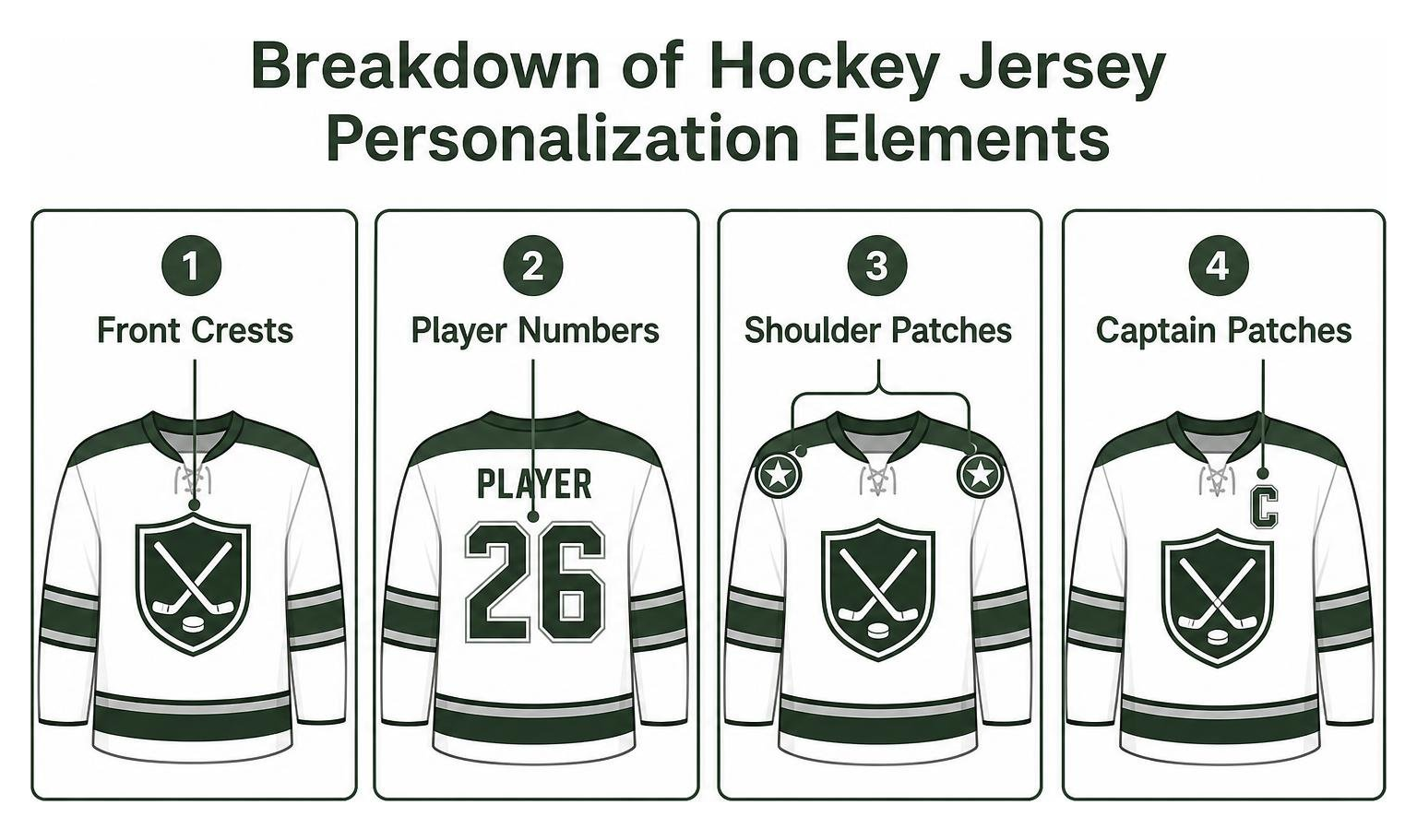
Breakdown of hockey jersey personalization elements: front crests, player numbers, shoulder patches, captain patches

Key personalization zones include:

  1. Main Front Crest: Positioned centrally across the chest, sized between 10 and 12 inches wide to maximize visual impact.
  2. Back Player Numbers: Ranging from 10 to 12 inches in height, back numbers must contrast sharply against the primary jersey color for clear identification from the referee crease and scorekeeper box.
  3. Shoulder and Sleeve Numbers: Typically sized at 4 inches tall, sleeve numbers help officials track player penalties quickly.
  4. Shoulder Patches (Secondary Logos): Placed high on the shoulders to showcase secondary emblems, state flags, or tournament logos.
  5. Captain and Alternate Patches: Crisp “C” and “A” designations, typically measuring 3 to 4 inches, positioned over the upper-left chest.

Ordering Logistics: Costs, Lead Times, and League Regulations

Organizing an apparel order for an entire roster requires clear budgets and timelines. Individual custom sweaters usually range from $55 to $130 per unit, depending on whether you choose fully sublimated lightweight options or multi-layer tackle twill with fight straps. Most programs take advantage of bulk team pricing by ordering game uniforms, practice jerseys, socks, and coach shells together.

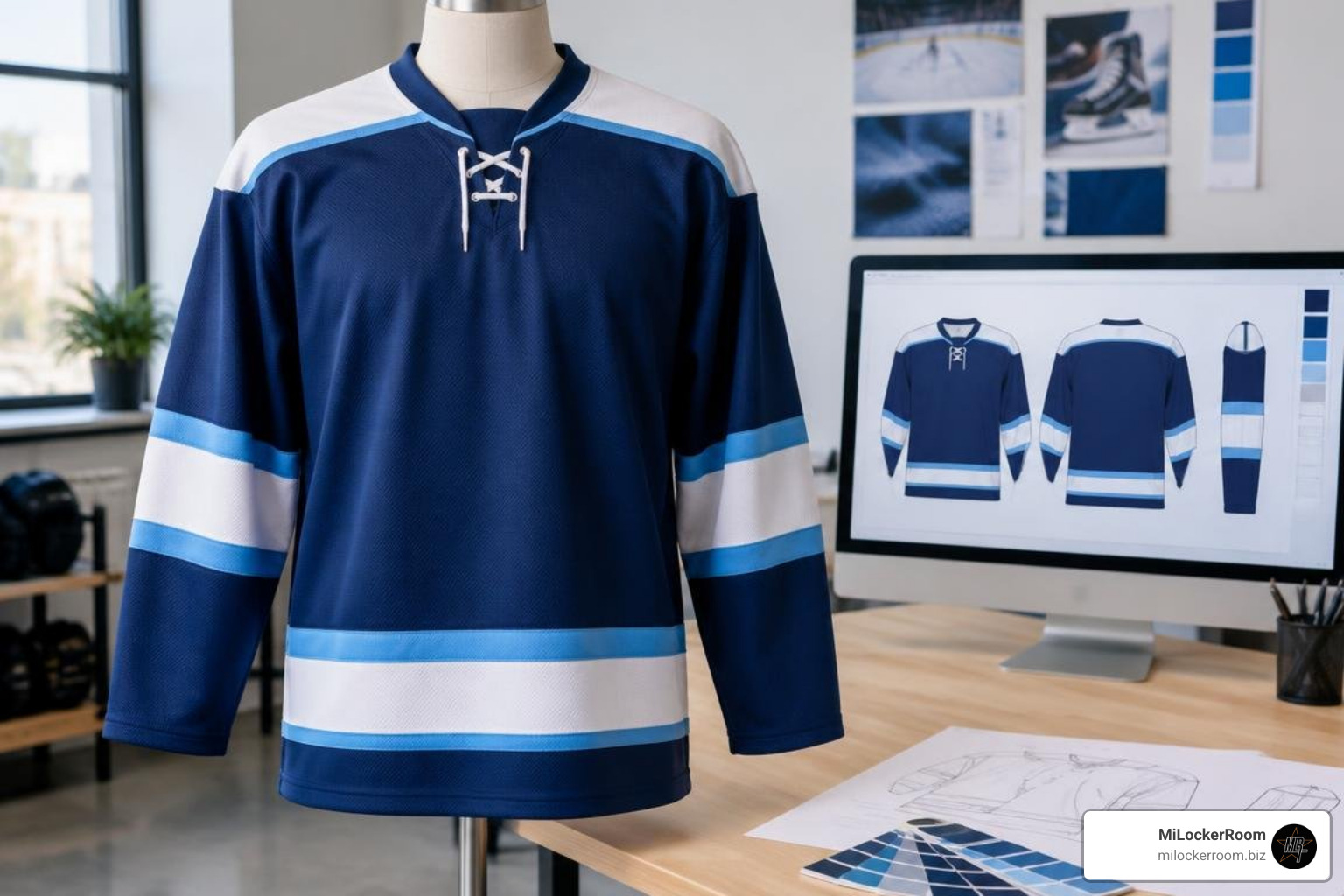
custom hockey jersey vector mockup and proof sheet

When ordering, factor in common scheduling constraints:

  • Design & Proofing Phase: 1 to 2 weeks for initial concepts, roster compilation, and final digital vector proof sign-off.
  • Production Turnaround: 3 to 6 weeks depending on the time of year. Summer and late fall usually bring higher demand ahead of winter seasons.
  • Shipping & Final Check: 3 to 7 business days for transit, sorting, and roster validation.

Always check your governing body’s rulebook before finalizing artwork. Our team regularly reviews sports apparel requirements to make sure designs pass inspection before production starts.

If your team competes in regional, national, or international tournaments, your designs must comply with established standard guidelines, such as the Art. 9 Uniforms — IIHF Rule Book. These regulations specify proper contrast between light home and dark away jerseys, along with precise nameplate sizing and number dimensions.

Best Practices for Washing and Caring for Ice Hockey Uniforms

High-performance hockey uniforms represent a significant team investment. Proper washing and storage habits will keep fabrics bright, prevent snagging, and preserve crest stitching for seasons to come.

  • Do:
    • Wash jerseys inside-out using cold water and a gentle wash cycle.
    • Fasten all Velcro straps on elbow pads and pants before storing them near jerseys to prevent snagging.
    • Use mild liquid detergent free of harsh optical brighteners or bleach.
    • Hang jerseys on broad plastic hangers to air dry completely after every skate.
  • Don’t:
    • Never use high heat in a tumble dryer; intense heat can shrink technical polyester, warp twill crests, and melt heat-applied adhesives.
    • Never leave damp, sweaty jerseys zipped inside an airtight equipment bag overnight, as trapped moisture breeds mildew and weakens fabric fibers.
    • Never iron directly over sublimated graphics, heat transfers, or embroidered patches.
    • Never mix game jerseys with heavy canvas bags, abrasive skate covers, or Velcro-heavy gear in the same laundry load.

Frequently Asked Questions About Custom Ice Hockey Uniforms

How long does it typically take to produce custom hockey jerseys?

Standard production generally ranges from 3 to 5 weeks once you approve your digital proofs and confirm your complete roster sizing. During peak fall ordering windows, planning for 5 to 7 weeks helps ensure your uniforms arrive well before your first pre-season exhibition game.

What is the difference between sublimated and tackle twill jerseys?

Sublimation infuses dye directly into the fabric strands, creating a smooth, lightweight, and durable jersey where artwork will never peel or crack. Tackle twill uses cut fabric patches and embroidery stitched onto the jersey, delivering a heavier, classic pro-style finish.

How do leagues regulate jersey colors and number placement?

Most leagues require teams to maintain two distinct uniform sets: a light base (white or cream) for home games and a dark base (navy, black, red, or royal) for away games. Numbering must contrast clearly against the main body fabric, typically measuring at least 10 inches on the back and 4 inches on the sleeves.

Conclusion

A well-crafted hockey sweater brings a squad together, turns heads at the rink, and stands up to physical game action week after week. Selecting durable knits, dialing in accurate sizing, and respecting league rules turns a simple uniform into an asset that players wear with pride.

At MiLockerRoom, we replace catalog guesswork with a personal, coach-led approach. We pair your team one-on-one with experienced coaches who understand hockey’s specific demands—from shoulder-pad drop to elbow reinforcement. With reliable in-house production, your gear is built right and delivered on time. If you are ready to update your look this season, connect with our crew and design your next uniform package directly. For custom sizing kits or team inquiries, Contact Us today.

Hit the Turf in Style with Pro-Grade Custom Field Hockey Jerseys

How to Design Custom Field Hockey Jerseys Your Team Can Count On

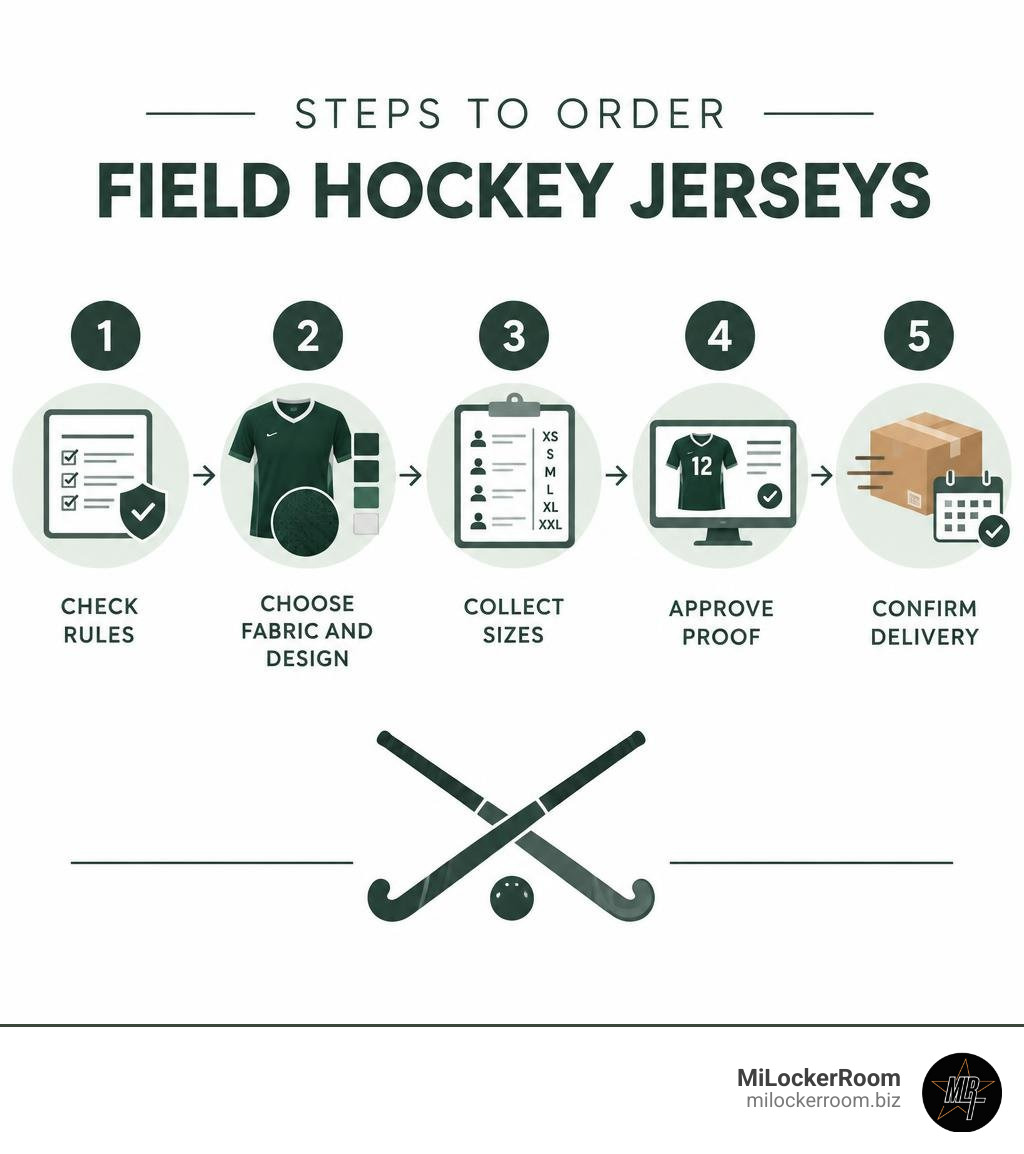
To design custom field hockey jerseys, check your league’s uniform rules first. Then choose team colors, a breathable fabric, and a design players can move in. Collect sizes, names, and numbers on one roster. Before you approve the order, check the design proof, total cost, and delivery date against your first game.

A good jersey should help players stay comfortable while making the team easy to recognize. MiLockerRoom pairs schools and clubs with experienced coaches for one-on-one design guidance, with production handled in-house.

Steps to order field hockey jerseys: check rules, choose fabric and design, collect sizes, approve proof, confirm delivery

Field hockey is played by over 30 million athletes worldwide across more than 130 countries. As the sport continues to grow, the demand for high-caliber, specialized team gear has skyrocketed. At the same time, the global custom sportswear market is projected to reach $5.4 billion by 2028, expanding at a steady compound annual growth rate of 6.2%. Today’s players and coaches expect gear that delivers both high aesthetic appeal and unmatched durability under physical game conditions.

Why High-Performance Custom Field Hockey Jerseys Outperform Stock Kits

Off-the-shelf catalog jerseys might seem convenient at first glance, but standard stock apparel often falls short when put to the test on game day. Field hockey requires unique body mechanics: low defensive stances, explosive multi-directional sprinting, quick stick rotations, and high-impact contact. Generic jerseys rarely accommodate these demands.

Investing in tailored custom team uniforms and apparel gives programs complete control over cut, fit, fabric performance, and aesthetic identity. Custom kits are tailored specifically for dynamic turf movement, ensuring your athletes focus on their positioning and ball control rather than adjusting ill-fitting sleeves or struggling with trapped heat.

Feature / Benefit Full Dye-Sublimation Jerseys Traditional Screen-Printed Stock Kits
Durability & Lifespan 40% longer lifespan; zero cracking, peeling, or fading Graphics often crack, flake, or peel after multiple washes
Breathability & Weight Ink becomes part of the yarn; 100% breathable and lightweight Thick ink layers create heavy, non-breathable “sweat patches”
Design Flexibility Unlimited colors, gradients, side-panel patterns, and custom fonts Limited ink colors; extra charges for each additional print color
Turf Abrasion Resistance Resists snagging and friction burns from artificial pitches Screen ink scuffs and wears away quickly upon impact
Compliance & Regulation Built from scratch to meet official NFHS, NCAA, and FIH rules May lack required number contrast, solid backs, or border margins

Stock jerseys also present supply chain headaches. When a stock line is discontinued by a mass manufacturer next season, teams are often forced to buy completely new kits for the entire squad just to outfit a handful of incoming freshmen. With fully customized production, your team patterns remain on file, making repeat orders and roster additions effortless year after year.

Performance Fabrics and Moisture-Wicking Technology

Modern field hockey is one of the fastest sports in the world, especially when played on wet or dry synthetic turf pitches. High-speed running and stick skills generate intense body heat. This is why moisture-wicking fabric jerseys account for 78% of all custom field hockey jersey orders.

When selecting materials for your squad, look for advanced technical fabrics such as:

  • Micro-Interlock Polyester: A smooth, tightly woven, lightweight fabric that resists snagging from sticks while providing a sleek drape.
  • Strategic Mesh Ventilation: Breathable pin-hole or jacquard mesh placed along the side panels, underarms, and lower back to promote active airflow and thermal regulation.
  • Four-Way Stretch Blends: Elastane-infused polyester that bends and rebounds alongside your players during deep lunges, sweeping passes, and reverse-stick hits.
  • Antimicrobial and Anti-Odor Treatments: Fabric finishes that actively prevent the buildup of odor-causing bacteria across double-header weekends and grueling tournament schedules.

Sublimation vs. Traditional Screen Printing for Long-Lasting Durability

One of the most important decisions when creating team tops is the printing method. While traditional screen printing applies a heavy layer of plastisol ink on top of the fabric, dye-sublimation uses heat and pressure to infuse dye directly into the polyester fibers at a molecular level.

Because the ink becomes a permanent part of the yarn, custom jerseys with sublimated designs have a 40% longer lifespan than screen-printed garments. Sublimation will not crack, peel, or flake, even after dozens of aggressive machine washes or heavy turf slides. Furthermore, because no heavy ink sits on the surface of the shirt, the jersey maintains maximum breathability and a featherlight feel in high-temperature conditions.

Step-by-Step Guide to Designing Your Team’s Field Hockey Uniforms

Designing a custom uniform from scratch should be an exciting and creative process for coaches, athletic directors, and team captains.

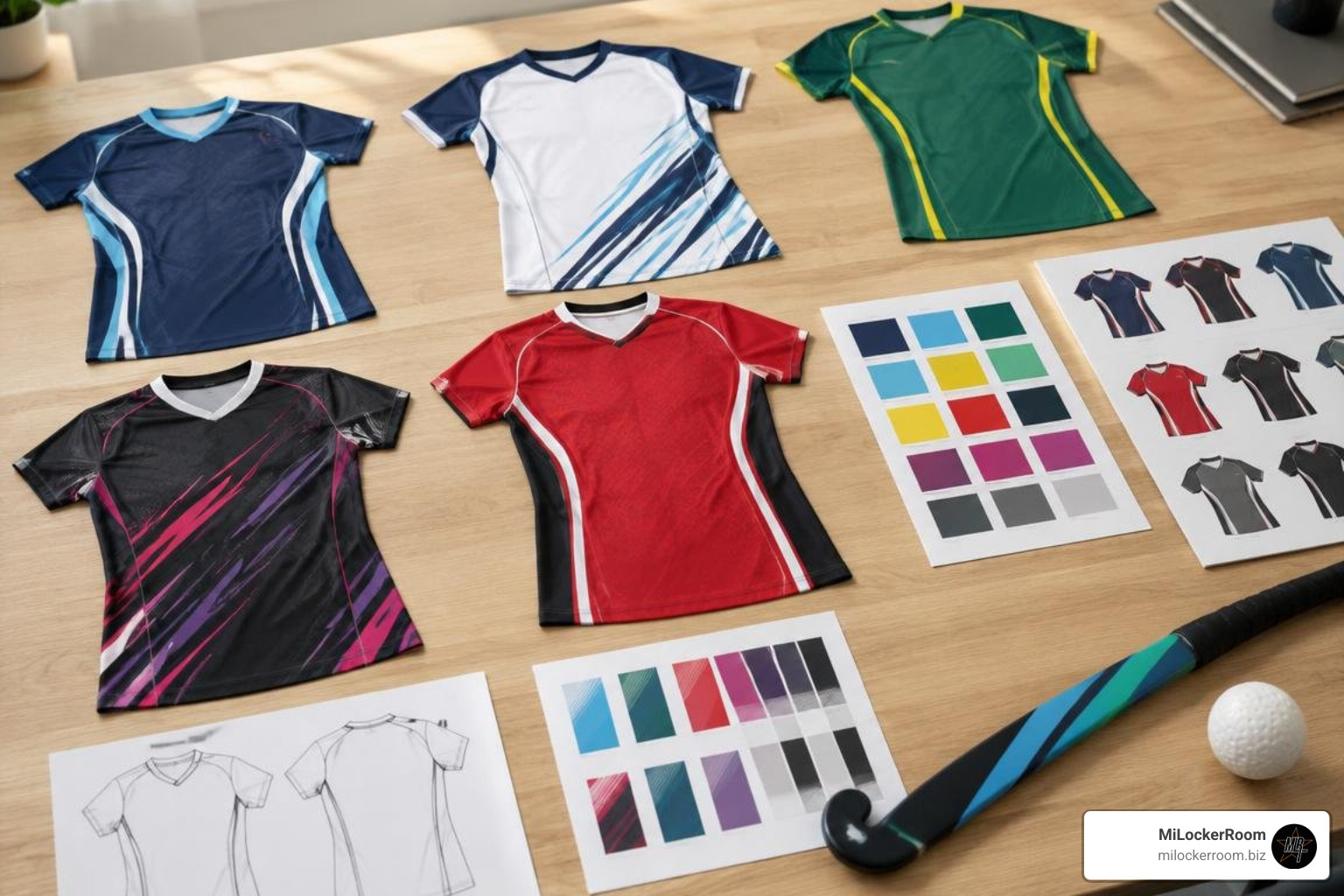
custom field hockey jersey design mockups and color templates

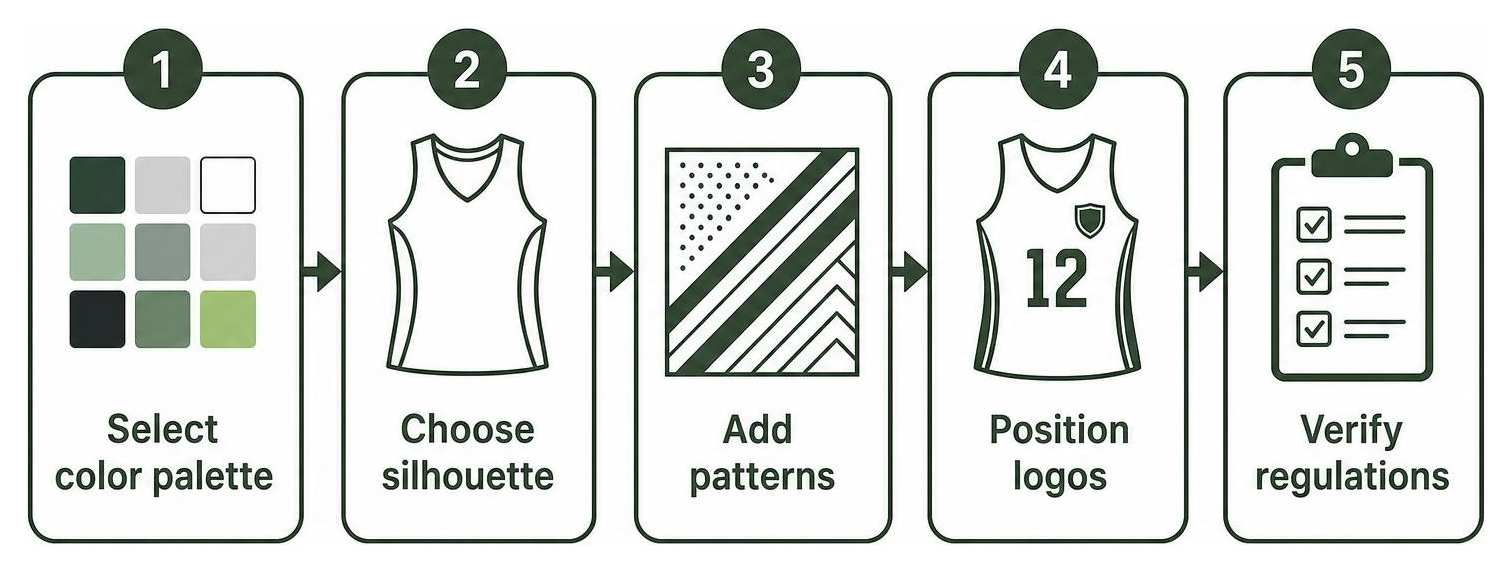
Here is a straightforward design framework:

  1. Select Your Core Palette: Identify your primary school or club color, a dominant secondary tone, and an accent color. Ensure your home kit uses light tones and your away kit uses contrasting dark tones.
  2. Choose the Cut and Silhouette: Decide between modern racerback cuts, sleeveless athletic tops, or traditional short-sleeve jerseys based on your team’s comfort and regional weather.
  3. Incorporate Dynamic Patterns: Elevate your look beyond plain solid blocks. Subtle geometric patterns, fading gradients, or custom shoulder stripes add a professional aesthetic.
  4. Position Identity Elements: Place your primary crest over the left chest, add high-contrast numbers on the front and back, and incorporate school mottos or mascot details along the inner collar or hemline.

Design workflow: select color palette, choose silhouette, add patterns, position logos, verify regulations

Essential Customization Options for Custom Field Hockey Jerseys

When designing top-tier custom jerseys, you have total creative freedom to build a uniform that represents your program’s culture and heritage:

  • Player Names & Numbers: Sharp, legible player names arched across the upper back paired with bold 6- to 8-inch back numbers and 4-inch front numbers.
  • Embroidered or Sublimated Crests: High-definition club shields, mascot artwork, or traditional school crests placed prominently on the chest.
  • Sponsor Integration: Dedicated placements on the sleeves, lower back, or chest for booster clubs and community sponsors, built right into the dye without extra weight.
  • Custom Necklines: Choose from athletic V-necks, modern crew necks, or hybrid collars tailored for jersey durability.

League Regulations and Jersey Compliance

Before finalizing any uniform art, verify that your design aligns with your governing organization’s official rulebook:

  • NFHS (High School): Home teams typically must wear white or light-colored jerseys, while visiting teams wear dark tops. Numbering must be clearly contrasting, centered on the front and back, and free of confusing background patterns that impede referee visibility.
  • NCAA (Collegiate): Strict guidelines govern front and back number sizes, manufacturer logo sizing (typically no larger than 2.25 square inches), and color contrast for both field players and goalkeepers.
  • FIH (International/Club): International regulations require opposing teams to wear distinctly contrasting shirts and socks. Goalkeepers must always wear a jersey color that clearly differentiates them from both their teammates and the opposing team’s field players.

Ordering and Production: Sizing, Timelines, and Bulk Savings

Proper planning and roster coordination eliminate the pre-season scramble and ensure your squad steps onto the turf fully outfitted on opening day.

custom sizing charts and athletic cut options for turf sports

How to Budget and Order Custom Field Hockey Jerseys in Bulk

Managing athletic department budgets requires smart procurement. Ordering your team gear in volume provides substantial savings that can be redirected toward travel, tournament entry fees, or new practice balls. In fact, teams that order custom jerseys in bulk (20+ units) save an average of 35% per jersey compared to single-unit orders.

Whether you are outfitting a middle school squad, varsity team, or entire regional club across various school and club sports, combining your uniform orders into a single batch run maximizes volume pricing discounts and keeps per-unit manufacturing costs as low as possible.

Sizing and Roster Planning for Peak Season Readiness

Fit is critical for high-speed athletic performance. Follow this timeline to ensure a smooth ordering experience:

  • 10–12 Weeks Before Season Opener: Request a physical sizing kit. Having players try on actual sample sizes ensures an accurate fit across standard and racerback cuts.
  • 8–10 Weeks Before Season Opener: Finalize custom artwork, select Pantone-matched colors, and verify roster details (player spellings, preferred numbers, and sizes).
  • 6–8 Weeks Before Season Opener: Sign off on the final digital proof and submit the production order.
  • 2–3 Weeks Before Season Opener: Uniforms arrive at your facility, allowing ample time for inventory verification and distribution before photo day.

Caring for Your Uniforms: Washing and Maintenance Best Practices

To protect your investment and preserve fabric performance year after year, follow these essential maintenance guidelines:

  • Pre-Treat Stains Immediately: Treat turf burn marks, mud, and grass stains promptly with a gentle enzyme stain remover before washing.
  • Wash in Cold Water: Always machine wash uniforms inside-out in cold water (below 85°F / 30°C) on a gentle cycle.
  • Use Mild Liquid Detergent: Avoid heavy-duty powder detergents, chlorine bleach, or brightening agents that can break down technical polyester fibers.
  • Skip Fabric Softeners: Fabric softeners leave a waxy coating that clogs technical micro-pores, severely reducing moisture-wicking and breathability.
  • Air Dry or Tumble Dry on Low: Hang jerseys to air dry whenever possible. If using a machine dryer, select a no-heat or low-heat cycle to avoid damaging the seams.

Frequently Asked Questions About Field Hockey Uniforms

What is the typical turnaround time for custom field hockey team kits?

Standard production for fully sublimated custom jerseys generally takes between 3 to 5 weeks after the final artwork and roster approval. We recommend starting the design and sizing process at least 8 to 10 weeks before your team’s first pre-season scrimmage to accommodate proofing and shipping.

What fabric is best suited for competitive field hockey jerseys?

A lightweight, 100% moisture-wicking micro-interlock polyester (ranging from 140 to 180 GSM) combined with breathable stretch-mesh side panels is the gold standard. It provides the ideal balance of snag resistance, flexibility, sweat management, and airflow.

How do bulk orders affect the overall cost of team jerseys?

Submitting bulk orders substantially reduces manufacturing setup costs per garment. Ordering in batches of 20 or more units typically yields up to 35% in savings per jersey compared to one-off replacement runs, making bulk procurement the most cost-effective path for clubs and athletic departments.

Conclusion

A well-designed, pro-grade field hockey jersey does far more than satisfy league rules—it builds program pride, enhances player comfort, and unites your roster into a confident, cohesive unit every time they step across the lines. By choosing durable technical fabrics, full dye-sublimation printing, and athletic cuts tailored for the sport, you ensure your team looks sharp and plays at its peak all season long.

At MiLockerRoom, we replace confusing online catalogs with direct, personalized guidance. We pair your team one-on-one with experienced coaches who understand the sport and guide your design from the ground up, backed by dependable in-house production.

Ready to elevate your squad’s turf presence this season? Visit our homepage and start designing your custom field hockey jerseys today.

Finding Top Custom Baseball Jerseys on Amazon for Teams and Fans

How to Find Custom Baseball Jerseys on Amazon

The best custom baseball jerseys on Amazon for a team are full button-down styles that let you add names, numbers, and a team name or logo. Listings include stitched and printed options in adult and youth sizes. One personalized jersey is listed at $10.99, but check the final price: shipping and customization choices can change what you pay.

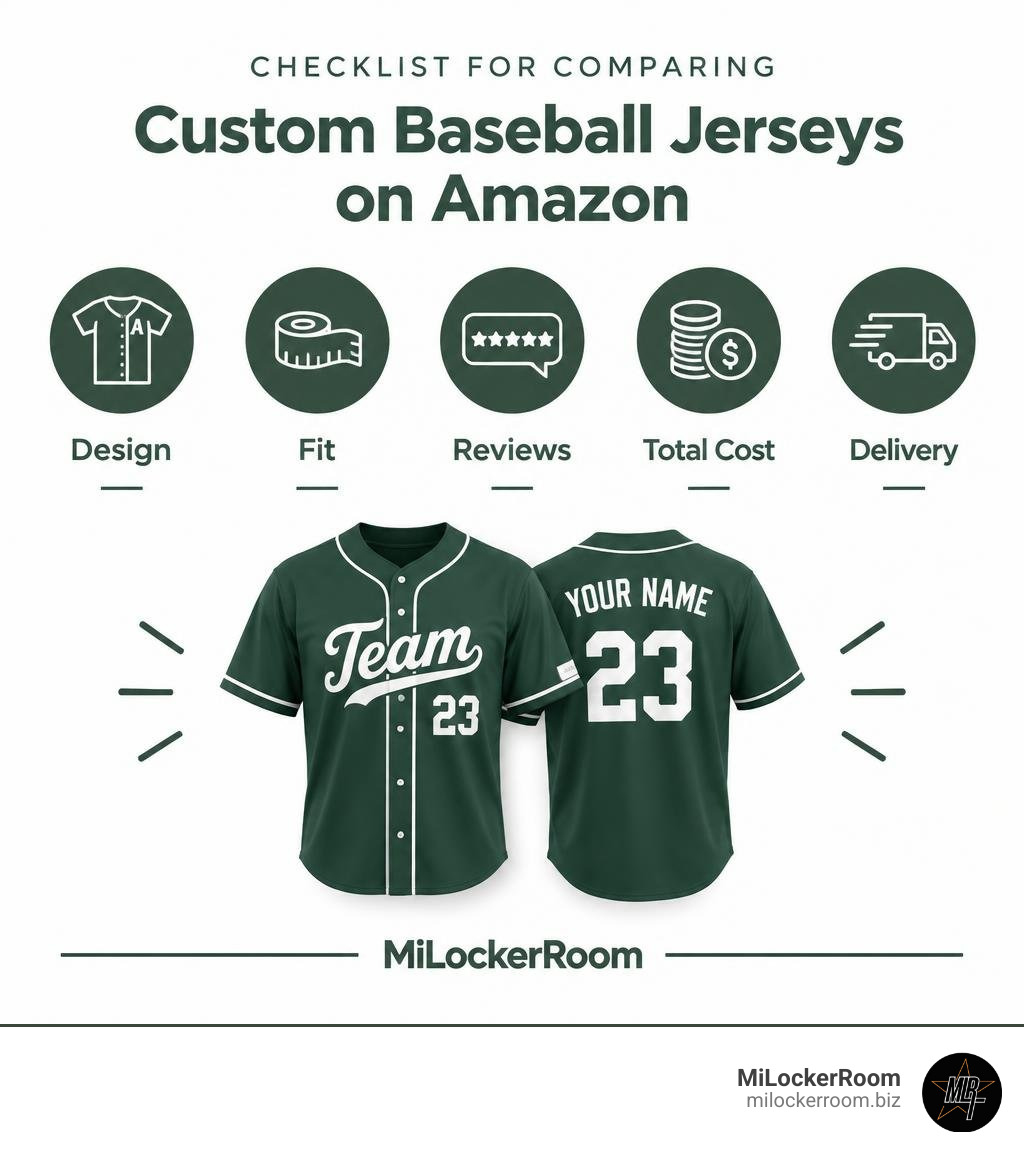
Before ordering a roster, compare each seller’s size chart, decoration method, and recent reviews of customized jerseys. Check the delivery estimate for every size and color, too. Personalized orders may take 10 to 14 or more business days, so leave room for changes before your first game.

Checklist for comparing custom baseball jerseys on Amazon: design, fit, reviews, total cost, and delivery infographic

Finding the right gear online can be exciting, whether you want to outfit a rec league squad, design matching shirts for a family tournament, or create a unique fan shirt. Because online marketplaces feature thousands of listings from independent sellers, sorting through the options requires a close eye for detail. Let’s take a look at the top styles, customization techniques, and key trade-offs you should know before clicking the buy button.

Top Picks for Custom Baseball Jerseys on Amazon

When shopping for custom baseball jerseys on Amazon, you will see a wide variety of designs ranging from retro button-downs to lightweight novelty shirts. In addition to custom team options, many shoppers enjoy checking out licensed fan merchandise—you can even browse fan gear listings on Amazon to see how professional replica jerseys are styled.

For personalized squad gear, listings generally fall into three main categories: entry-level printed tops, mid-tier stitched shirts, and multi-color retro button-downs. To help you evaluate the landscape, here is how typical marketplace options compare:

Jersey Type / Listing Style Base Price Range Customization Method Typical Review Score Estimated Delivery Window
Budget Printed Uniform $9.49 – $11.99 Heat-applied Vinyl / Screen Print 4.4 out of 5 stars (1.4K+ reviews) 10 to 14 business days
Stitched Button-Up Jersey $10.99 – $18.98 Tackle Twill / Machine Embroidery 5.0 out of 5 stars (Selected listings) 12 to 16 business days
Blank Hip Hop / Casual Top $13.46 – $14.95 None (DIY / Heat Press Ready) 4.4 out of 5 stars (1.8K+ reviews) 2 to 5 business days
Retro Striped Team Shirt $15.00 – $22.00 Sublimation / Multi-layer Stitch 4.6 out of 5 stars (1.5K+ reviews) 10 to 15 business days

Stitched vs. Printed Custom Baseball Jerseys on Amazon

One of the biggest choices you will make when ordering is deciding between stitched embroidery and printed graphics.

  • Stitched Tackle Twill: Stitched jerseys use fabric lettering sewn directly onto the garment. This technique delivers an authentic, professional appearance that stands up to frequent sliding, dirt, and repeated trips through the washing machine. While stitched options look sharp, they often take slightly longer to produce and require careful inspection around interior seams to prevent skin chafing during intense play.
  • Printed Graphics (Vinyl & Screen Printing): Printed jerseys apply rubberized vinyl or ink using heat presses. They provide crisp lines for intricate chest logos and bold colors. However, heat-applied numbers can crack or peel over time if dried on high heat. If you need shirts for a one-weekend company tournament or a casual barbecue softball game, printed options are cost-effective and lightweight.

Comparison of stitched embroidery versus vinyl printing for baseball apparel

Budget-Friendly Custom Baseball Jerseys on Amazon

If keeping costs low is your top priority, marketplace listings offer some surprisingly cheap entry points. Base prices for unbranded personalized baseball shirts often start between $9.89 and $10.99 per unit.

These budget-friendly tops are ideal for:

  • Recreational kickball and slow-pitch softball leagues.
  • Bachelor parties, birthday events, and themed gatherings.
  • Youth camp teams where players quickly outgrow their uniforms in a single season.

That sellers offering ultra-low base prices often attach separate shipping fees (frequently between $5.99 and $7.99 per item). Make sure to check the total cart price before finalizing your order so you stay on budget.

Full Button-Down Personalized Team Uniforms

For an authentic baseball look, full button-down jerseys remain the gold standard. These shirts feature classic vintage styling, breathable 100% polyester mesh fabric, and contrast braided piping down the placket and around the sleeves.

Most top-rated listings offer both youth sizes (ranging from extra small to youth large) and adult unisex sizes (from small up to 3XL or 4XL). The full button construction gives players the flexibility to wear the jersey loose over an undershirt or fully buttoned during competitive league matches.

What to Look for When Buying Custom Baseball Apparel

Buying team apparel through third-party catalog sellers requires extra due diligence compared to standard e-commerce shopping. Because customized items cannot easily be returned, paying attention to materials, sizing, and fulfillment fees is essential.

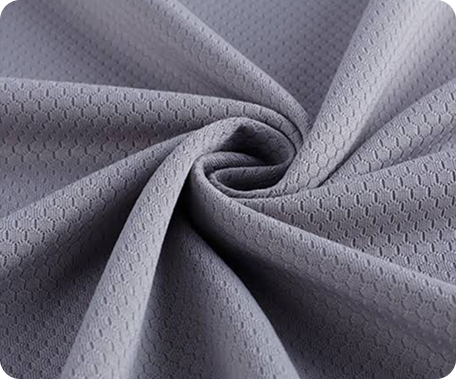
baseball jersey stitching and fabric detail

Fabric and Moisture Management

Baseball is a summer sport, and standing in the outfield under direct sun requires breathable fabric. Look for listings that specify moisture-wicking, interlock polyester or ventilated pinhole mesh. Heavy cotton blends might feel soft initially, but they trap sweat and become heavy during long doubleheaders.

Sizing and Roster Fit

Marketplace sizing can be inconsistent. Many third-party sellers use Asian sizing standards or tailored cuts that run narrower than traditional American athletic fits. Always check the chest circumference measurements in the listing’s sizing chart rather than ordering based solely on letter sizes (S, M, L). If a player falls between two measurements, ordering one size up ensures a comfortable, non-restrictive swing.

Fulfillment Windows and Shipping Costs

Unlike standard marketplace items that arrive on your doorstep in two days, customized products require hands-on production. From the moment you submit your team roster and numbers, manufacturing and shipping typically require 10 to 14 or more business days. If you are ordering before opening day, build in at least a three-week buffer to handle potential shipping delays.

When managing an entire squad, exploring high-quality custom team uniforms gives you direct oversight over fabric choices, color matching, and roster organization.

Marketplace Ordering vs. Dedicated Team Uniform Providers

While marketplace platforms are great for one-off novelty tops or budget-friendly recreational shirts, ordering an entire league or school roster through automated forms can present challenges.

baseball team wearing coordinated custom jerseys

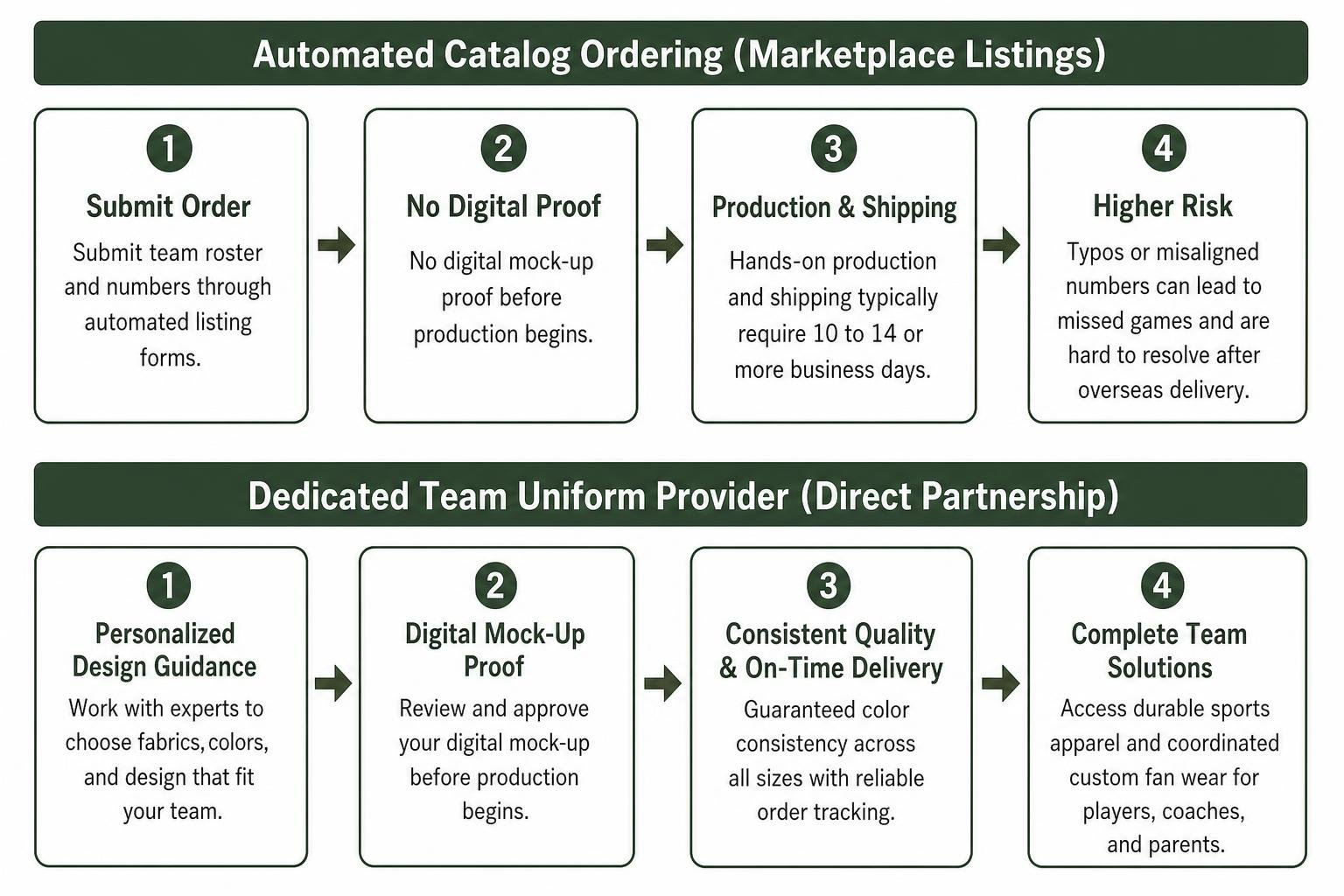
When you order custom gear through automated listings, you rarely receive a digital mock-up proof before production begins. If a typo occurs or a number is misaligned, resolving the issue after overseas delivery can lead to missed games.

Working with a dedicated uniform partner changes the entire experience. Instead of guessing how your logo will look, teams benefit from personalized design guidance, guaranteed color consistency across all sizes, and reliable order tracking. In addition to on-field kits, having access to durable sports apparel and coordinated custom fan wear ensures your players, coaches, and parents look unified from the dugout to the bleachers.

Workflow difference between automated catalog ordering and dedicated uniform design

Frequently Asked Questions About Custom Baseball Jerseys

How much do custom baseball jerseys cost on Amazon?

Base listing prices on Amazon typically range from $9.89 to $18.98 per shirt. However, total costs depend on whether you select printed or stitched personalization, as well as third-party shipping fees that usually add $6.00 to $8.00 per jersey.

How long does delivery take for personalized jerseys ordered on Amazon?

Because custom orders require individualized production and are frequently fulfilled overseas, delivery generally takes between 10 to 14 business days. During peak spring baseball and softball seasons, turnaround times can stretch past two to three weeks.

How do you ensure the right fit when ordering jerseys online?

Always measure across the widest part of your chest and compare those numbers directly to the seller’s specific size chart. Baseball jerseys are designed with a relaxed, loose fit to allow a full range of motion while batting and throwing, so sizing up is recommended if you plan to wear an undershirt.

Conclusion

Finding the right custom baseball jerseys on Amazon comes down to balancing price, decoration quality, and turnaround time. Whether you choose low-cost printed tops for a weekend outing or stitched full button-down shirts for a rec league team, always double-check sizing charts and shipping estimates well before opening day.

When you need unmatched quality, exact roster sizing, and professional design support, standard catalog ordering can leave room for error. At MiLockerRoom, we pair your team one-on-one with experienced coaches who provide ground-up design guidance and reliable in-house production. Ready to get your squad game-day ready? Visit our main page to outfit your roster with high-quality custom baseball uniforms built to perform all season long.